
We met a taxi driver named Yudi, who told us he did tours (as do many taxi drivers), and one he provides is a visit to Prambanan and then to nearby Mt. Merapi to see the lava flow (as Mt. Merapi is still an active volcano). He showed us videos of taking other tourists to see the lava flows, and we were definitely interested. Yudi gave off a friendly vibe, so we decided to take him up on his offer. He dropped us at the gate to Prambanan and we didn’t have to walk far to see the temples in the distance.
The other major historical temple site in Jogjakarta, after Borobudur, is the Prambanan Temple Complex (or Candi Prambanan), situated south of Jogja city. Originally built in the 9th century, these Hindu temples faced abandonment and weathered the elements multiple times over the years.
It wasn’t until they were rediscovered in the 1700s, and reconstruction began in the 20th century that the main six temples look like they do today. Originally, there were 224 temples, but abandonment, and subsequent earthquakes, destroyed most of them. Recently, the 2006 earthquake and 2014 nearby volcano eruption of Mt. Merapi caused more repairs to be made.
We arrived in the late afternoon, as we had heard it was a good place to watch the sunset, and the temperature was cooler. It was a cloudy day, though, with some blue sky that would occasionally appear.

Yudi said they had guides to hire at the entrance, and it was a really reasonable price, so we did. Our guide was named Wagiyo, and he had been a guide for many years. As the Prambanan complex is not huge, the tour was only an hour, and well worth it. There are three main temples, the largest dedicated to the Hindu god Shiva (or Siwa), flanked by the temples to Brahma and Vishnu. These are the three main deities in Hinduism, called the Trimurti. Brahma is the creator, Vishnu, the preserver (of balance), and Shiva the destroyer.
Wagiyo led us inside the temples, up more steep steps like we found at Borobudur. Inside there are no lights, so Wagiyo used his flashlight to show us the statues. The other three smaller temples are dedicated to the mounts of those gods, Nandi (bull), Garuda (bird) and Hamsa (swan). Wagiyo said to whisper wishes into the ear of the bull, Nandi (because he talks to Shiva), so we did, and to touch Ganesh’s snout for wisdom (Ganesh is in the Shiva Temple).


We did get some blue sky for a bit before the clouds moved in:


There are still two hundred of the smaller, surrounding temples that are rubble, and will not be rebuilt. Part of the reason the rebuild took a long time is that many of the original stones were taken by locals and re-used to build dwellings over the past hundreds of years. The earthquakes also provided some preservation of some reliefs and carvings, as, when they fell from earthquakes, they were better preserved resting in the dirt, than being exposed to the elements, as can be seen in the two relief carvings below:


Here is the overhead view of the temple map and a model of what it looked like with all the temples fully standing.


The Shiva Temple is 154 feet high (47 m) and is the tallest temple in the entire complex.


Wagiyo also told us the story that is found in the carvings and reliefs on Shiva’s temple, of the Ramayana. It is quite the tale from Hindu folklore, and takes many twists and turns. To paraphrase, Rama is an incarnation of Shiva (or Siwa), and he has a wife, Sita, who is kidnapped by the demon Ravanna (or Rahwana). Rama has to go on a mission to save Sita, with help from the monkey god, Hanuman, and his brother. Rama eventually succeeds in rescuing Sita with Hanuman’s help and buries Ravanna under a mountain. Rama, however, doesn’t trust that Sita was faithful, as Ravanna was a powerful demon, and has her burn in fire; if she is still pure, the fire will not harm her. She does not burn, and Rama and Sita are happy together once more. (There are more parts to the story, but those are the broad strokes; it is some epic).
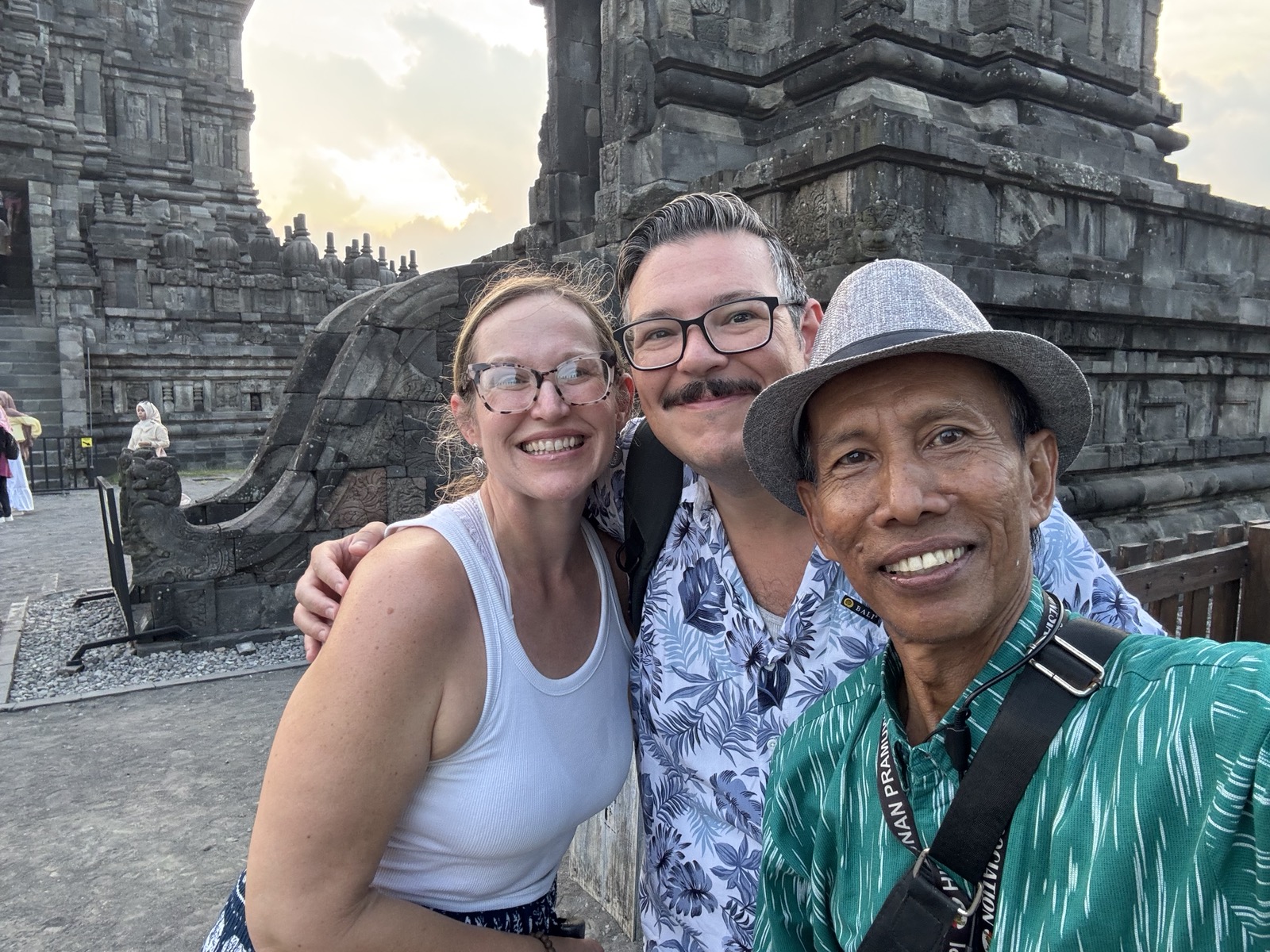
The clouds were not clearing, and it appeared we would miss the sunset; sometimes that happens, so we moved on, saying goodbye to Wagiyo but not before a selfie.

The Prambanan Temple is not the only temple on the site, and many visitors do not visit the three other temples, that are directly behind it, situated in a straight line. We had the time, so we went to explore. Wagiyo said there is a shuttle that would take us the one kilometer to the farthest one, and then we could walk back. We found the shuttle, but they said we needed to wait for more people, and we asked how long we would wait…and they shrugged. They implied we should walk it instead, so we started off, a little miffed, and really sweaty.
We walked to the farthest temple first, and there were only a few other people there. There is a fence and it was closed, but we could still view the Sewu Temple. It was built in 792 AD is is older than Prambanan. There are 249 surrounding, smaller temples (many have been reduced to rubble and not rebuilt) and was built during the time of the Ancient Mataram Kingdom.


We then stopped at the Bubrah Temple (which means “destroyed” or “damaged” in Javanese), and it describes the state of the temple when it was first discovered. It has been restored by the time we saw it.


The last temple we visited (and the closest one to Prambanan) is the Lumbung Temple. Walking through the park was nice as there are lots of big trees and green grass.


Lumbung Temple has a main shrine surrounded by 16 smaller ones; we only were able to see it quickly as the guards were closing the gates to it once we arrived.


We walked past Prambanan and there were many people relaxing on the grass outside the big temple complex.

We headed toward the exit, and were able to see the temple where we entered to begin the day, but with many less people around. We lingered a bit, taking in these massive structures.


Of course, there is a long exit pathway, past many, many vendors selling miniature temples and other souvenirs. We met up with Yudi and he said there was a lot of fog on the mountain, as there is a live youtube stream of Mt. Merapi, but it would take us an hour and half to get there, so it might clear up. He asked if we wanted to eat dinner first, and we said yes, and he knew a place (every driver knows a place to eat).
He also asked if we had planned to see the Ramayana ballet show, which is performed at the Prambanan. Well, Jessica had looked into getting tickets but they were sold out online, so we accepted it wasn’t for us this time. Yudi said, though, that they have to keep tickets for onsite sales the night of the event, and that he had taken some other tourists the week before to the show, the night of. He turned the car around, and we went back to the Prambanan ticket office; he asked them if there were tickets, and they said yes, come back in an hour, when the box office opened. That gave us time to get dinner, and we returned to buy tickets and watch the show.
We went to dinner of good Indonesian food; and returned and bought tickets. We were going to the show! We entered the theater and took some silly pictures too.


Then we entered the outdoor theater, and took our seats; the seats are not the most comfortable, they are hard stone, which did become a bit uncomfortable after a while. We are glad our guide, Wagiyo, told us the Ramayana story, as there are no spoken words during the ballet; and while there are screens that tell the story to the right and left of the stage it alternates between English and Indonesian and isn’t super descriptive.
In any case, it was an impressive show, with many performers, lights, and with the background of the Temple, (almost) made us forget about the stone seating.


The highlight was the fire show from the story, it was a lot more fire and fireworks than expected.


It was quite the show and highly recommend it if visiting Prambanan!


We met back up with Yudi, and he said it was still cloudy on Mt. Merapi; so we decided it was the lava flow that wasn’t for us that evening, and went back to the hotel. Prambanan was just as impressive as Borobudur and in some ways more so, but when in Jogjakarta, one should go to both. All of the art we saw in Jogja coming up next!


Well this seems like a really cool place to visit – it’s so ancient!
LikeLike
It was so cool, and so well done to rebuild. they showed some pictures of what it looked like before they restored it, and it looked pretty run down. Now, its truly magnificent
LikeLike
What a cool place to visit – it’s ancient and I love the history!
LikeLike